Multi-modal integration of CyTOF and CITE-Seq data
Abhishek Koladiya
Cytof_CITESeq_DataIntegration.RmdThe CellFuse package enables reference-based integration and cell type prediction across modalities (e.g., CyTOF and CITE-seq). This vignette provides a step-by-step demonstration of how to train a supervised contrastive learning model using a CyTOF reference and apply it to predict cell types in a query datase
Before using CellFuse, users must ensure a proper Python environment is configured through the reticulate package. This section sets the Python interpreter path, creates a virtual environment, installs necessary Python dependencies (such as torch, pandas, and scikit-learn), and initializes the environment for R to communicate with Python seamlessly. These steps are essential for running the deep learning model underlying CellFuse.
library(reticulate)
use_condaenv("myenv", required = TRUE)
py_config()
## python: /opt/homebrew/Caskroom/miniforge/base/envs/myenv/bin/python
## libpython: /opt/homebrew/Caskroom/miniforge/base/envs/myenv/lib/libpython3.10.dylib
## pythonhome: /opt/homebrew/Caskroom/miniforge/base/envs/myenv:/opt/homebrew/Caskroom/miniforge/base/envs/myenv
## version: 3.10.19 | packaged by conda-forge | (main, Oct 22 2025, 22:46:49) [Clang 19.1.7 ]
## numpy: /opt/homebrew/Caskroom/miniforge/base/envs/myenv/lib/python3.10/site-packages/numpy
## numpy_version: 2.2.6
##
## NOTE: Python version was forced by use_python() function
library(CellFuse)As shown in Data Preparation vignette we splitted reference data in to training and validation subsets. Now let’s train CellFuse model using reference data (CyTOF)
ref_dir <- system.file("extdata","Cytof_CITESeq","Reference_Data",package="CellFuse")
pred_dir <- system.file("extdata","Cytof_CITESeq","Predicted_Data",package="CellFuse")

#### Train model using Levine32 data ###
TrainModel(dataset_name="Levine32",data_dir=ref_dir,
           save_path=pred_dir,device="cpu",cluster_column="cluster.orig",
           lr=as.numeric(0.0009),margin=as.numeric(0.8), bs=as.integer(256),
           epoch=as.integer(50),k=as.integer(5), min_delta=as.numeric(0.01),
           patience=as.integer(5), val_step=as.integer(5),
           output_dim=as.integer(8), dropout_prob=as.numeric(0.7),
           activation_function='leaky_relu',alpha=as.numeric(0.01))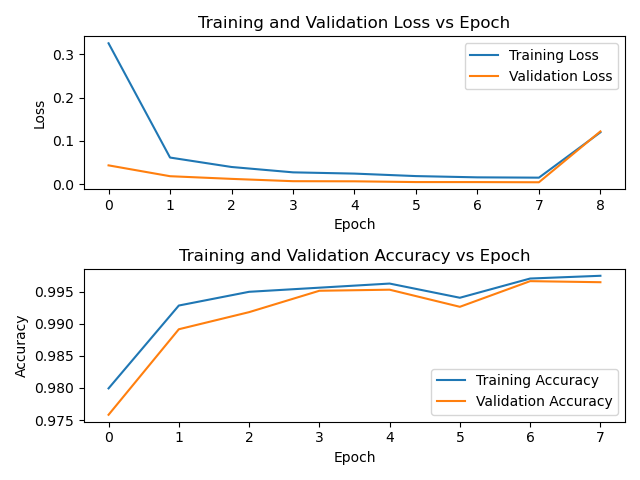
Training curve on CyTOF reference
Now let’s use this model to Predict cells in query (CITE-Seq) data
ref_dir <- system.file("extdata","Cytof_CITESeq","Reference_Data",package="CellFuse")
pred_dir <- system.file("extdata","Cytof_CITESeq","Predicted_Data","Saved_model",package="CellFuse")
query_dir <- system.file("extdata","Cytof_CITESeq","Query_Data",package="CellFuse")

### Predict CITEseq data ###
PredictCells(dataset_name="Levine32",data_dir=ref_dir,
             test_data_dir=query_dir, test_data="CITEseq",
             model_dir=pred_dir,model_date = "2025-11-24",
             device="cpu",cluster_column='cluster.orig',
             lr=as.numeric(0.001),margin=0.5,
             bs=as.integer(256),epoch=as.integer(50),
             knn_k=as.integer(5),output_dim=as.integer(8),
             dropout_prob=as.numeric(0.5),activation_function='leaky_relu')
## Loading the model: /private/var/folders/31/95qcf9qd5xd8jlgntfp59yjr0000gp/T/RtmpaGFVLq/temp_libpath161161e93452c/CellFuse/extdata/Cytof_CITESeq/Predicted_Data/Saved_model/Levine32_2025-11-24.pt
## Projecting embeddings...
## Fitting KNN model...
## Predictions saved to ./Pred_CITEseq_Ref_Levine32_2025-11-24.csv.Finally, integrate reference (CyTOF) and query data (CITE-Seq)
Levine32_path <- system.file("extdata","Cytof_CITESeq","Reference_Data",
                             "Levine32_train.csv",package="CellFuse")

CITESeq_path <- system.file("extdata","Cytof_CITESeq","Query_Data",
                            "CITEseq_test.csv",package="CellFuse")

# Integrate query data with reference
corrected_data <- IntegrateData(ref_path = Levine32_path,
                                query_path = CITESeq_path,
                                Celltype_col = "cluster.orig")
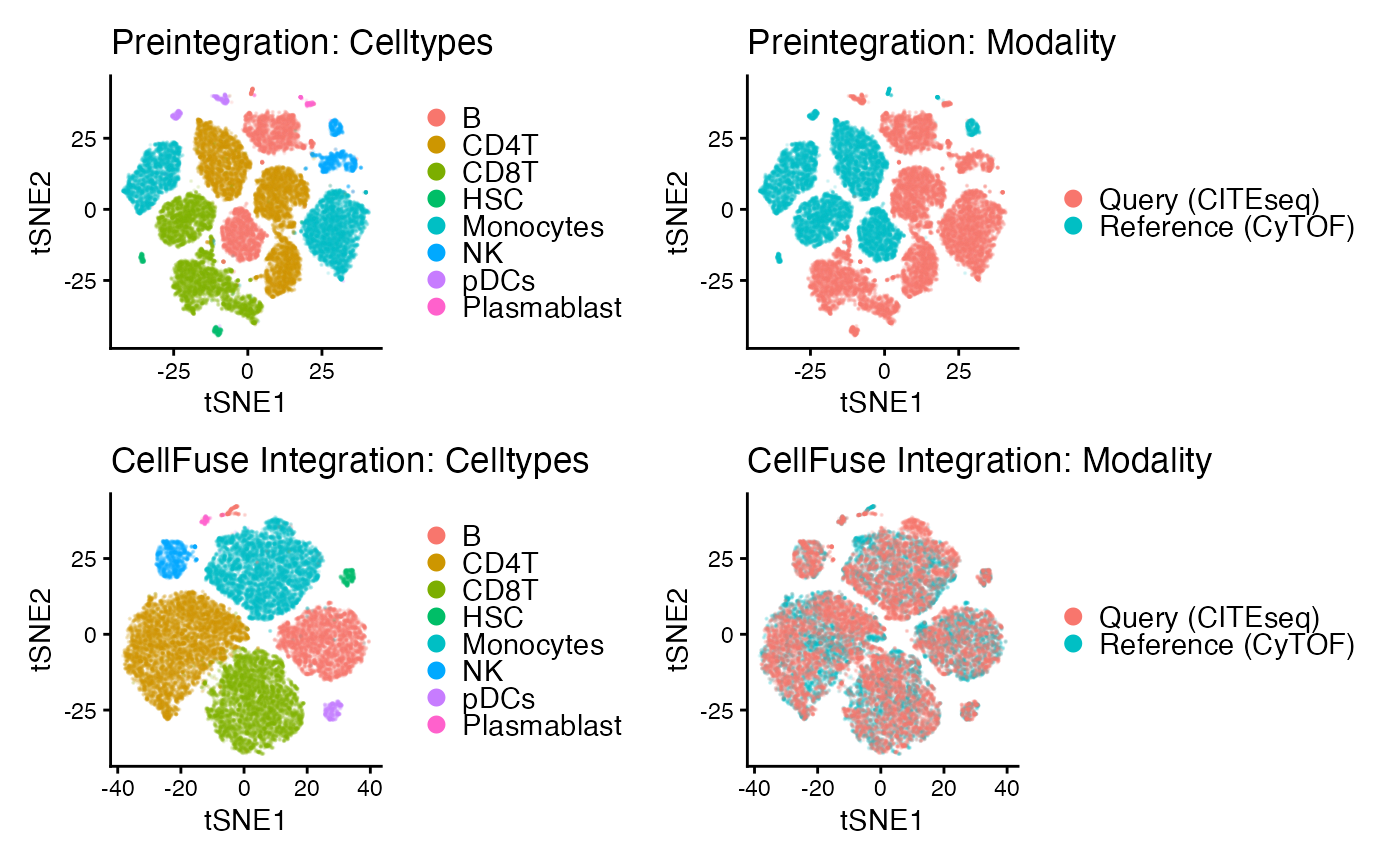
Create pre- and post integration dataframes and run tSNE on both
## Merge pre-integrated data ##

Levine32 <- read.csv(Levine32_path)
CITESeq  <- read.csv(CITESeq_path)

# Pre-integration merge
Levine32$batch <- "Reference (CyTOF)"
CITESeq$batch  <- "Query (CITEseq)"
Preintegration <- rbind(Levine32, CITESeq)

# Post-integration merge (corrected_data should be a data.frame)
PostIntegration <- rbind(transform(Levine32, batch = "Reference (CyTOF)"),
                         transform(corrected_data, batch = "Query (CITEseq)"))

## Run tSNE ###
library(Rtsne)

e_pre<- Rtsne(Preintegration[,1:12])
colnames(e_pre$Y)= c("tSNE1","tSNE2")
e_post<- Rtsne(PostIntegration[,1:12])
colnames(e_post$Y)= c("tSNE1","tSNE2")

Preintegration=cbind.data.frame(Preintegration,e_pre$Y)
PostIntegration=cbind.data.frame(PostIntegration,e_post$Y)
Visualize pre and post integrated data
library(ggplot2)
library(patchwork)

base_theme <- theme_classic() +
  theme(legend.title = element_blank(),
        legend.text  = element_text(size = 11),
        legend.key.size = unit(3, "mm"))

P1 <- ggplot(Preintegration, aes(tSNE1, tSNE2, colour = cluster.orig)) +
  geom_point(size = 0.1, alpha = 0.1) + base_theme + ggtitle("Preintegration: Celltypes") +
  guides(colour = guide_legend(override.aes = list(size = 2.5, alpha = 1)))

P2 <- ggplot(Preintegration, aes(tSNE1, tSNE2, colour = batch)) +
  geom_point(size = 0.1, alpha = 0.1) + base_theme +ggtitle("Preintegration: Modality") +
  guides(colour = guide_legend(override.aes = list(size = 2.5, alpha = 1)))

P3 <- ggplot(PostIntegration, aes(tSNE1, tSNE2, colour = cluster.orig)) +
  geom_point(size = 0.1, alpha = 0.1) +base_theme +ggtitle("CellFuse Integration: Celltypes") +
  guides(colour = guide_legend(override.aes = list(size = 2.5, alpha = 1)))

P4 <- ggplot(PostIntegration, aes(tSNE1, tSNE2, colour = batch)) +
  geom_point(size = 0.1, alpha = 0.1) +base_theme +ggtitle("CellFuse Integration: Modality") +
  guides(colour = guide_legend(override.aes = list(size = 2.5, alpha = 1)))

(P1 | P2) / (P3 | P4)